

Table Of Contents
- What is Judicial Separation?
- What is Divorce?
- Differences Between Judicial Separation and Divorce
- When to Choose Judicial Separation Over Divorce?
- Conclusion
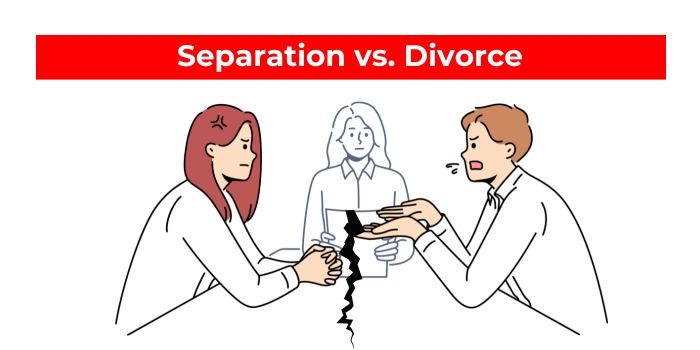
Marriage is a legal and emotional bond between two individuals, but not all marriages work out as expected. When a couple faces irreconcilable differences, they may consider legal options such as judicial separation or divorce. While both involve living apart, they have distinct legal implications. This blog will explore the key differences between judicial separation and divorce, their procedures, and their effects on marriage.
What is Judicial Separation?
Judicial separation is a legal process where a married couple remains legally married but lives separately. It serves as a middle ground for couples who are not yet ready for divorce but need legal recognition of their separation.
Key Features of Judicial Separation:
- The couple remains legally married.
- Spouses can live separately and make individual financial and personal decisions.
- It provides time for reconciliation if the couple wishes to reunite.
- Legal obligations such as maintenance and child custody are determined by the court.
Grounds for Judicial Separation in India
Under the Hindu Marriage Act, 1955, judicial separation can be granted based on the following grounds:
- Adultery
- Cruelty
- Desertion for at least two years
- Conversion to another religion
- Mental disorder
- Venereal disease
- Renunciation of the world
- Not heard alive for seven years
Procedure for Judicial Separation
- Filing the Petition – One spouse files a petition in the family court.
- Notice to the Other Party – The other spouse receives a legal notice.
- Court Hearing – Both parties present their arguments and evidence.
- Judgment – If the court is satisfied, it grants judicial separation.
What is Divorce?
Divorce is the legal termination of a marriage, ending all marital rights and obligations between the spouses. After divorce, both individuals are free to remarry.
Key Features of Divorce:
- The marital relationship is completely dissolved.
- Both parties are free to remarry.
- Division of assets and alimony are legally settled.
- Child custody is determined by the court.
Types of Divorce in India
Divorce in India can be classified into Mutual Consent Divorce and Contested Divorce.
Mutual Consent Divorce
Under Section 13B of the Hindu Marriage Act, both spouses agree to end the marriage amicably.
- Requires a separation period of at least one year.
- The couple must agree on alimony, child custody, and property division.
- A waiting period of six months is provided before the final decree.
Contested Divorce
When one spouse does not agree to the divorce, the other can file a contested divorce based on specific grounds:
- Adultery
- Cruelty
- Desertion
- Mental disorder
- Impotency
- Venereal disease
- Religious conversion
- Not heard alive for seven years
Procedure for Divorce
- Filing the Petition – One or both spouses file for divorce.
- Legal Notice and Response – The other spouse is notified and given time to respond.
- Court Hearing – Both parties present evidence and arguments.
- Reconciliation Attempts – The court may suggest mediation.
- Final Judgment – If reconciliation fails, the court grants the divorce decree.
Differences Between Judicial Separation and Divorce
| Factors | Judicial Separation | Divorce |
| Legal Status | Marriage remains valid | Marriage is completely dissolved |
| Right to Remarry | Not allowed | Allowed |
| Purpose | Temporary separation, with a chance of reconciliation | Permanent dissolution of marriage |
| Financial Obligations | Spousal maintenance and financial support continue | Financial matters are settled permanently |
| Child Custody | Decided by court, but still under shared parental responsibility | Permanent custody arrangements decided by court |
When to Choose Judicial Separation Over Divorce?
- When the couple is unsure about permanently ending their marriage.
- If religious or societal reasons prevent immediate divorce.
- When financial or personal stability requires some time before divorce.
- If there is a possibility of reconciliation.
Conclusion
While both judicial separation and divorce provide legal remedies for troubled marriages, they serve different purposes. Judicial separation allows couples to live apart while remaining legally married, whereas divorce ends the marriage completely. The choice between the two depends on personal circumstances, financial considerations, and future intentions.


 Legal Lead
Leave a comment